The Global Folk Revival: Why this is the biggest movement yet
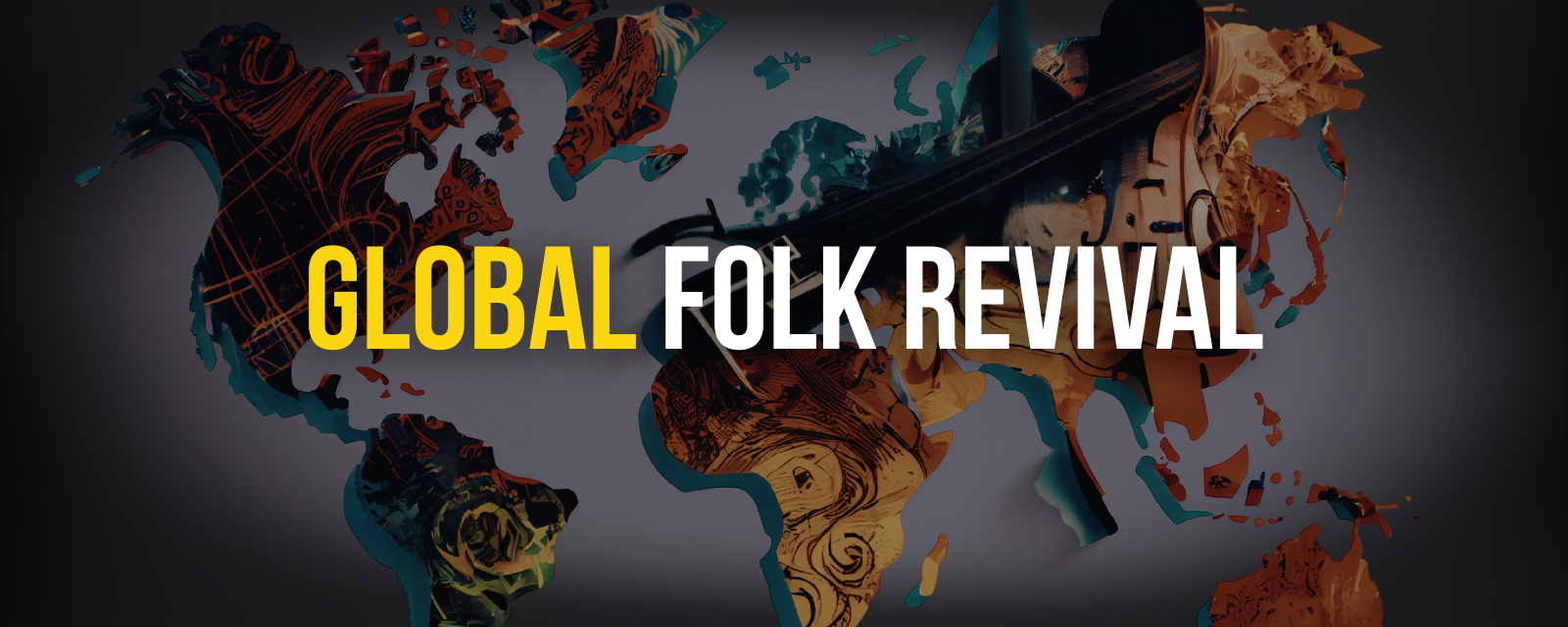
There is a real shift happening right now. People are showing a growing interest in the past, looking for a bit of simplicity away from all the modern noise. If you feel that nostalgic pull getting stronger, you are in good company. We are actually right in the middle of another Folk Revival. This time, however, it is happening on a global scale - and it seems to be flying completely under the radar.
The reason for it is quite straightforward. The world is moving at a pace that is genuinely tough to keep up with. Living costs are climbing fast, and there is a ridiculous subscription fee attached to nearly everything. It feels like an episode of Black Mirror that everyone has just accepted as normal. At the core of it all, people simply want to belong. They want to feel connected to their homeland and their roots while the world shifts rapidly around them. The fascinating part is that we have seen this exact cycle before.
What is a Folk Revival and what does the Framework consist of?
What triggered these movements in the past? Let's take a closer look at the actual moving parts. These revivals happen quite often, and they rarely stick to a single country. At the center of every single one, you will find two driving forces: the people and their environment. Once we understand what kicked off the older revivals, we can compare them to how things look today. It paints a much clearer picture.
Before we get into what a Folk Revival actually is, it helps to start a bit smaller. What exactly is folk music? Simply put, it is traditional music passed down through generations by word of mouth. It naturally grows and shifts within a culture over time. This is music of the people, for the people. It relies heavily on storytelling to paint a picture of a specific moment in time. That picture could be as mundane as working out in a field or having a few pints, or it could drop you right into the shoes of a man locked up and shipped away for stealing corn to feed his children.
Now, not everyone enjoys stereotypical folk music, and that is perfectly fine. But it stands completely apart from other genres because it is so deeply connected to our history.
So, what is a Folk Revival then? It is basically when people make a conscious choice to pick up this old music again, but not just music. They bring back the language, the traditions, the dancing, and the stories right along with it. This happens even if, in the case of music, they did not learn the songs directly from their own parents or grandparents, which is the usual way folk music manages to survive. It is a purposeful, planned return to a culture's roots. In our connected world, plenty of things can act as a spark to set it off. A band getting popular might help, but there is always a much deeper reason driving the whole thing.
The psychological and sociological drivers of a folk revival are deeply tied to societal anxieties. Revivals do not emerge in periods of cultural stasis; they are reactive mechanisms triggered by rapid modernization, commercialization, cultural imperialism, or profound economic instability. When the pace of technological or societal change accelerates beyond a comfortable human scale, populations frequently experience a sense of temporal displacement and alienation. Cultural theorists conceptualize this reactionary impulse not merely as a sentimental longing for "simpler times," but as an active rebellion against the modern idea of linear time and the relentless, isolating march of industrial progress.
When I first read that bit above there for the first time, it struck me how familiar it all sounds. Instant messaging and video calls are brilliant to have, but if it is so convenient to connect with people, why does it sometimes feel like a chore? I find myself thinking about this some mornings over a coffee, just pondering random owld shite. As you do.
When we were younger, a conversation was a single event. You sat down face-to-face with someone, or a group of friends, and everyone took part in the one topic. Now, I can be messaging my parents, my brothers, my wife, and my friends all at the exact same time about completely unrelated things. It is absolutely exhausting. One chat might be genuinely stressful, while the next is about the hilarious consequences of too many pints and a dodgy Chinese takeaway. Try to imagine sitting in a physical room with everyone talking at you like that all at once. It would be completely nuts and potentially, pure embarrassing.
That is just one example, and I don't know, maybe I am the only one who feels that way. But you have to admit, things are moving so fast right now that it is genuinely hard to keep up. It is perfectly normal to get a bit overwhelmed by it all. Maybe I just miss the days when you would tell your friends in school, "I will meet you at the spot in town at 3pm on Saturday," and you simply had to trust that they would actually show up.
But let's park that thought for a minute and get back to the main point.
Looking at what we covered earlier, a Folk Revival is driven by a search for something real. When the world gets overly commercialised and mainstream culture starts feeling a bit empty, people naturally look for a sense of familiarity. They want to feel rooted in something genuine.
That point is backed up by a lot of the comments you all left on a recent post I made on the owld YouTube channel there. I will share a few of those comments at the end of this article for you.
But look at traditional songs. You can take them out of their original context and use them to talk directly about the exact issues we are dealing with today, like loneliness, money troubles, or political frustration. I read an interview recently with the band The Mary Wallopers - who are from the best town in Ireland, by the way. Charles Hendy made a brilliant point regarding the housing crisis and their music in general taking off.
“… It was kind of surprising when The Mary Wallopers started taking off. Looking back it makes total sense, the music can travel, it’s a lot more listenable. But at the time, we were like ‘what the fuck?’ because when we started playing ballads it was not cool.”“I think it’s housing crisis and all that shit. It’s kinda depressing… you can sing a song that’s 400 years old about landlords and you don’t even need to change the lyrics.”
That perfectly captures the anger surrounding the housing situation right now, at least. But it’s just one example, there’s many more, and absolutely not confined to Ireland alone. People are tired. It is also the exact way a Folk Revival takes root.
How do we know if we’re in the middle of a Folk Revival?
But hang on, how do we know for sure? Did folks back then realise they were in the middle of a revival, or did they only look back and stick the label on it years later? It is a bit like a recession... which might be a grim example... where you are in the thick of it, but it only gets officially marked after two quarters of things going south. Do we need two consecutive quarters of positive folk album sales to say we are actually in one?
Well, we have already identified the main markers. A Folk Revival is the active choice to seek out things like traditional music and reconnect with our own culture. It extends to all the other traditions too. It is also spurred on by the increasing anxieties in the world around us. So yes, once you see those things happening, you can make a fairly solid guess that we are currently in the middle of one. It explains an awful lot of what is going on globally today.
But what about the previous ones?
Previous Folk Revivals
Let's look at a few of the previous folk revivals. There was one in the early 2000s that revolved heavily around acoustic storytelling. As I mentioned earlier, these movements do not stick to just one or two countries; they can happen absolutely anywhere. But the revivals I want to focus on are the ones I know best... the 1950s and the tail end of the 1800s.
The Mid-20th Century Folk Revivals (1940s - 1960s) - The American Folk Revival
Take the 1950s. These were the years immediately following the Second World War. Over in the United States, Senator Joe McCarthy was driving the Red Scare. The establishment was absolutely terrified of anything that even vaguely resembled Communism. Because folk music had such a long history of supporting unions and the working class, it became a massive target. High-profile groups, like The Weavers, were effectively blacklisted and silenced, which pushed the music straight underground.
I say it all the time... if you want to make a song popular, ban it.
The whole thing backfired spectacularly. Folk music turned into a pure symbol of rebellion in spots like Greenwich Village in New York. The younger crowd knew they were doing something important by digging up those old songs. They saw it as an honest, authentic alternative to the plastic commercial culture of the time, even if they did not have a fancy name for the movement yet.
People actively searched for older songs from the Great Depression and rural America to feel grounded and push past the fake social norms of the day. The word "folk" was front and center from the start. In May 1950, a magazine called Sing Out! began openly sharing "the people's music" specifically to fight back against the mainstream commercial culture.
The resurgence kicked off with American acts like The Weavers - featuring Pete Seeger, who we just mentioned got blacklisted - along with the Kingston Trio and Peter, Paul and Mary. The list goes on, and I couldn't possibly name them all here.
But because Ireland is so deeply connected to the States, we saw the Clancy Brothers rise up on the back of that wave around 1961. That triggered a massive domino effect back home, inspiring the exact same movement in Ireland. We suddenly had bands like The Dubliners, The Chieftains, Sweeney's Men, and The Wolfe Tones coming through. It is also worth pointing out that before the Clancys ever went near a TV camera, Seán Ó Riada was already pioneering his own movement. He released the groundbreaking soundtrack for Mise Éire in 1959, and followed it up with Ceoltóirí Chualann in 1960.
Folks knew they were in the thick of something big at the time. However, it was only later on that the whole era was officially stamped in the history books as the Second Folk Revival.
So, why did it end? Why didn't it just keep going?
Ironically, the very thing the revival was protesting against ended up being a major reason it fell apart, along with a few other factors. It is really interesting to look at, especially if we want to figure out if we are in another Folk Revival right now. The framework is never going to look exactly the same twice.
The mid-century revival lasted for roughly two decades before rapidly fracturing in the mid-1960s. Here are the three main things that brought it to a close:
💼Commercialisation: The movement started as a protest against commercial culture, but it ironically became dependent on it. Acts like The Kingston Trio hit the massive pop charts with polished, clean versions of folk songs like "Tom Dooley" in 1958. This shifted the genre from grassroots protest right into mass-market television entertainment.
⚡Going Electric: The strict, acoustic purity demanded by the traditionalists was shattered in 1965. That was when Bob Dylan famously plugged in an electric guitar and played a set with the Paul Butterfield Blues Band at the Newport Folk Festival. Rock music quickly absorbed the folk sound, creating new fusion genres like folk-rock and effectively ending the strict traditionalist run.
🚷Rigid Rules: Over in the UK and Ireland, the free-flowing, radical pub sessions eventually became institutionalised. By the 1970s, pub owners were paying core groups of musicians to play every week. That introduced rigid customs, unwritten rules, and predictable setlists, which completely stifled the spontaneous, "join-in" energy the movement originally started with.
Keep in mind, if we want to understand what is happening right now, it is not going to look exactly like the 1950s. The core elements are the same, but they are mixed together differently today. Take the Clancy Brothers, for example. Their massive success was built right on top of that commercial platform we just talked about. Those famous Aran sweaters they always wore were a deliberate choice to serve a specific audience. That polished image might actually be part of the reason the revival eventually ran its course.
The Gaelic Revival (Late 19th and Early 20th Centuries)
Now, let's rewind a good bit further back to the late 1800s. Think about the Gaelic Revival in Ireland. This movement kicked off as a direct response to centuries of British colonial rule. The country was barely back on its feet after the Great Famine, and the island was being rapidly Anglicised.
This gives us a completely different trigger compared to the 1950s, but it provides a great comparison for what we might be experiencing today.
Back then, Irish culture was genuinely fading away. The native language and the traditional music were being actively erased by imperial policies. But the people refused to simply sit back and let it happen. They fought back by organising. They formed the Society for the Preservation of the Irish Language in 1876, the GAA in 1884, and the Gaelic League in 1893. All of these groups were formed with a singular focus: to protect our roots and de-Anglicise the country.
| Historical Revival | Primary Catalysts for Emergence | Key Figures & Institutions | Mechanisms of Decline |
| Gaelic Revival (Late 19th C.) | British colonialism, Famine trauma, Anglicization | W.B. Yeats, Douglas Hyde, Gaelic League, Abbey Theatre | Absorbed by state institutions (Irish Free State); became conservative status quo. |
| Mid-20th Century Revival (1940s-1960s) | Cold War anxiety, 1950s social conformity, rapid commercialization | Woody Guthrie, Pete Seeger, Bob Dylan, Ewan MacColl | Subsumed by commercial rock/pop; fragmented by electric instrumentation; institutionalization. |
Is there a Global Folk Revival happening right now?
Living over here in Japan, I keep a fairly close eye on the news… well not really, it’s hard to avoid doing the usual endless scrolling on Reddit when you’re bored. The feed just throws all sorts of stuff at me. But there seems to be a movement of sorts happening right now to preserve traditional Japanese culture. There is plenty of controversy surrounding it, which we don’t need to dive into here. But one of the main policymakers behind it made a very straightforward point: a country's culture is the single most important thing to preserve if you want to keep its identity intact. Which I absolutely agree with.
If a country loses its culture, what is actually left? It goes right down to the local accent. Let's try a wee thought experiment here. Imagine if Ireland and Scotland simply had no traditions or culture - if they straight up did not exist, all the way down to the accent (What would we ever do without the Cork accent by the way). How could you possibly tell if someone was Irish or Scottish without demanding to look at their passport?
When you strip away the culture of a place, a person can lose a massive chunk of who they actually are.
Now, look at the world today. Globalisation is everywhere. We are living our lives online, and as a result, we are feeling increasingly disconnected from our roots. There is AI built into your fridge. You have to pay a monthly subscription fee just to use ink in your own printer. You scroll through social media, and suddenly a person sitting in a house in the middle of Europe is deeply invested in the politics of the United States. Global events impact us directly, and we are constantly bombarded with the news of it all.
Much like the end of the 19th century, we are drifting further away from our native culture through absolutely no fault of our own. The world is so hyper-connected now that local traditions are becoming a rare thing.
So, how do we reconnect? We have to actively put the phones down and go out looking for it.
That means reading the history, having a go at the language, and listening to the old songs. It means supporting the bands who are out there championing these tunes. As those groups gain traction, we naturally start finding other folks who feel the exact same way we do.
As I mentioned at the very beginning, a Folk Revival happens when people make a conscious choice to seek out their heritage. It is a practical way to step away from the frantic pace of modern life and find a bit of solid ground in a chaotic world.
Sounds awful familiar, doesn't it? It’s not just me?
Here is another wee thought experiment for you. Imagine it is 2030 and there is AI-generated music all over the shop, with AI videos everywhere you look. You walk into an art exhibition, and everything on the wall is generated by a computer, complete with a little plaque underneath showing the prompt the "artist" typed in to make it.
It sounds completely ridiculous. Because it is. I like to think things will never actually get to that point.
But just imagine for a second that this was your reality. If you suddenly stumbled across a place dedicated entirely to purely human-made music and storytelling, what would you do? I think the vast majority of folks would deliberately seek out the authentic stuff. This drive for real, human connection is going to be a massive factor in the next Folk Revival, whether we are already in the middle of it right now or it kicks off in the next few years.
This brings us to the complicated part. We can easily look back at history and understand the old revivals because the events are already fully documented. But if it is happening right now, who is actually standing at the forefront of it today?
The reason I say it is a bit more complicated today is this: the 19th-century revival I was on about earlier was largely confined to Ireland. The 1950s movement started in the United States and had a massive knock-on effect in Ireland and the UK because it is no surprise we are all so deeply connected. I am fairly sure it reached Australia and New Zealand at some point too. I have to apologise to anyone reading this down under, as I haven't dived too deeply into that side of the history just yet. I have generally always viewed it as a US, Irish, and UK movement.
Basically, a Folk Revival is not something that has to happen globally, nor does it have to be confined to one single country. It happens as a direct result of what we mentioned already - social and economic anxieties pushing people to deliberately seek out old traditions to feel grounded.
So I honestly don't know how far this current one will reach. I certainly do not think it will be confined to just the English-speaking world. Like I mentioned earlier, living here in Japan gives me a different perspective, and I see a growing interest in preserving culture happening right in front of me for various reasons.
This could very well be a massive global phenomenon. I absolutely do not have the resources to confirm the true scale of it, but from what I do know, the root cause is simple. It all boils down to basic human nature and the desire to feel connected to who we actually are.
What do you think about it?
It could also very well be a case where certain generations miss this movement altogether. Take folks born between the late 1990s and the early 2000s, for example. Their college years were completely upended by the pandemic. After that, they were thrown straight into a working world where mass layoffs are common and AI is suddenly everywhere. It might hit different for other generations altogether.
For Irish Folk Revival, what Bands would we be talking about in another 20 years?
But if we were to fast forward a few decades into the future and look back at the 2020s... who do you think historians will say actually led this modern Folk Revival?
For Irish music at least, you would likely see a few main pillars standing out.
Take The Mary Wallopers. I mentioned them earlier when talking about that 400-year-old song about landlords. They took a centuries-old track, kept the lyrics exactly as they were, and it resonated perfectly with the housing crisis we have today. They act as a direct echo of the 1960s ballad boom. They are essentially a modern mix of The Dubliners and The Pogues.
Then you have Lankum. They are pulling traditional songs into much darker, experimental territory. When they deliver the lyrics, they actively force you to feel the heavy weight of the actual story.
Over in the United States, the Dropkick Murphys serve a similar foundational role. They have been going strong since the late 1990s. Whenever I read through the comments you all leave on my past videos and posts, their name constantly pops up as the primary gateway for the American diaspora trying to connect with their Irish roots today.
And then... you have Kneecap.An Irish hip-hop group might raise a few eyebrows in a conversation about folk music. But go back to the core definition: folk is the music of the people. These lads are speaking directly to the realities faced by a massive portion of the youth up in Belfast and right across Ireland. Even Shane MacGowan recognised their place within the tradition. Taking the raw elements of our culture and reshaping them through hip-hop opens the concept of folk up to an entirely different demographic. It expands the reach completely.
This is exactly why it feels like we are standing at the beginning of a completely new phase of the movement.
At this stage, I don't think anyone could accurately document exactly what is happening on a global scale. There are simply far too many moving parts. We are entirely speculating based on the patterns of the past.
But it seems a fair few of you are thinking the exact same way. When I asked recently if you felt we were going through a Folk Revival of sorts, the response was brilliant. Let's take a look at a few of the comments you left:
Cameron:“I feel like younger people are trying to belong, connect to something deeper within themselves and within their home lands. Folk music goes hand in hand with that, whether it's Irish folk music, Scottish folk music, so on and so fourth. After all, folk music is steeped in ancient history and can have a lot of deep meaning which people are craving in this sometimes shallow feeling world, especially nowadays.”
Ledatape:“I'm based in Melbourne, Australia where there are massive scenes of diverse musics. The folk scene used to be a bit of a fringe thing but thanks to a lot of dedicated and smart folkies they've really opened up the folk scene here - there are so many strands to it now. I think some of it comes down to some people being sick of technology everywhere. I just folded up my hard rock group to go acoustic but that was coz I was fed up of having to yell over the amplifiers and losing my voice.”
Stephen:“I think it is but it is quite different to the earlier versions. Back in the day, learning Trad music was limited by the availability of material to learn from and study. Vinyl, and cassette copies of vinyl, as well as some great books were the sources of inspiration for me and my peers. We would pore over these things trying to take in as much as we could. They were precious things. These days technology has changed how that works. We have so much to choose from that it can be difficult to curate things and sort the good from the bad or follow a particular path. There do seem to be more Irish Trad players around near me than before. And when I go to a festival I see a lot more young people walking around with fiddles over their shoulders. Whether that points to a folk revival I’m not sure. It certainly isn’t dying.”
Kathleen:“I agree it is time and in my life I have seen when the world is in tough times-The music takes over. I really hope the music takes over.”
Haunted Furniture:“I surely hope so... but I do also think so. It's needed; It's time.”
It is absolutely time.
Just enjoy reconnecting with your Culture’s roots, no matter where you are
But look, I could make a fairly good stab at it based on what is happening in Ireland. I genuinely feel like there is a revival of sorts happening back home. But trying to gauge the United States, the UK, Australia, New Zealand, and the rest of the world? That would be nearly impossible to label. You would need some kind of technology that could somehow read everything on the internet, make sense of what is happening on a global scale, and spit the answer out for you. If you know what I’m talking about, give it a try for yourself and see what it says.
What I do know is this. If there is a global Folk Revival going on right now, it needs the exact same stress factors that sparked the Gaelic Revival and the American Folk Revival. Looking around at the state of things today, I firmly believe we have no shortage of them.
Potentially, this could be the biggest cultural movement we will ever see written about in the history books. But we will only know for certain once it finally runs its course.