Banish Misfortune
About the Tune
'Banish Misfortune' is a popular Irish tune played on various instruments, including fiddle, banjo, guitar, and accordion.
What it sounds like: People often describe the tune as having a "keyless" feel, with a smooth transition between notes at the beginning. It is best played at a steady, medium pace, avoiding a rushed tempo.
How it's structured: The tune typically has three parts (A, B, and C). The order of these parts can vary; some versions are A-B-C, while others are 1A, 1B, 1A, 1B, and 2C. Traditional Irish dance tunes are often arranged AABBCC.
Musical Details:
- The tune is in D mixolydian, which means it’s based on the D scale but with a C natural. This results in a single sharp in the written music.
- Some players use a 9/8 time signature for the first part, with a unique rhythmic pattern. This is speculated to be an older version appearing on recordings.
- Several musicians, including Richard Thompson and Patti Larkin, have recorded guitar versions of the tune.
Recordings and Performances: There are numerous recordings available online. Sean Keane’s version is well-known, though some prefer Ian Walsh’s or Gerry O’Connor’s interpretations. The tune was also featured in the film 'Agnes Browne,' performed by Paddy Moloney.
Origin and Names: There are rumors about the tune's name relating to the Banes (or Danes) and the English crown or possibly relating to Spanish soldiers from the Armada. These are unconfirmed speculations. Sometimes, humorous, invented names like "Mammy's Horse is Dying" are playfully used, inspired by a comedy video.
Variations: A version transcribed from Johnny McCarthy’s album, "Steele’s Rock," exists, as do slight variations on previously posted settings. Some players experiment with flattening the leading tone in the B part. There’s a reported version played with F naturals, creating a unique sound. There’s also a version played by Elvis Costello and the Chieftains in the key of B minor.
Learning Resources: A step-by-step guide for learning the tune on the Irish flute and tin whistle is available on Tunes & Tools.
Get ready for the session
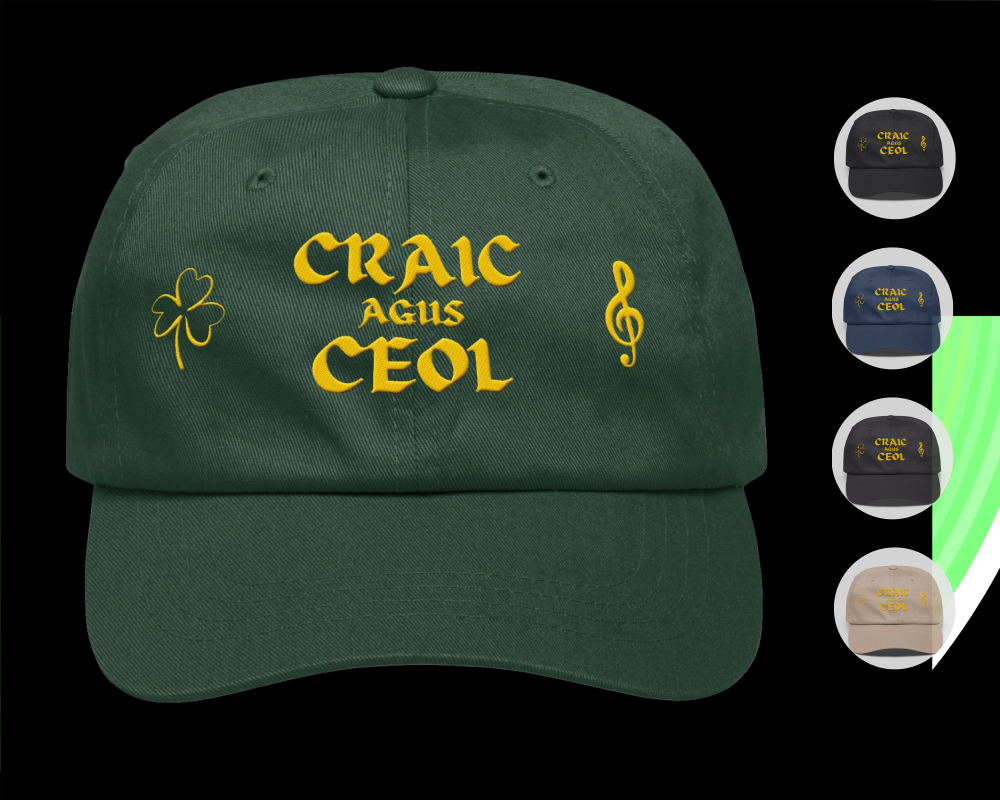
Irish Music Hat - Craic agus Ceol Classic Cap
What does 'Craic agus Ceol' mean? It simply means 'Fun and Music' in Irish. This classic cap is perfect for any session or festival, and is a great way to show your love for Irish music and culture. For a limited time also, get 10% off using the code TUNEWEB10 at checkout. Just as a thanks for using Inside Irish Music for practicing some tunes today.
Cheers,
Ronan.
Listen and Learn the Tune:
Tunes to Try Next
Disclaimer: Much of this tune background is hard to trace, and some details remain speculative. These summaries draw on trad community discussion and other available sources, and will be updated as better verified information emerges. If you spot an error or have confirmed information to add, please get in touch and I'll update the site.