The Lilting Banshee
About the Tune
'The Lilting Banshee' is a popular Irish jig. It is often played alongside other tunes like 'The Butcher's March' and 'Road to Lisdoonvarna.'
Origins and Names:
The tune’s history is complicated. It has been known by several names, including:
- 'The Miller of Glanmire' – This is the name used by Mary Bergin when she taught the tune in Scotland in 2002. It also appears under this name in the well-known collection, 'O’Neill’s 1001.'
- 'The Butcher’s March' – Some musicians play it under this name, leading to speculation that the two names may have been confused at some point.
- 'The Wailing Banshee' – At least one musician from Chicago uses this name.
- 'The Moyasta Jig' – Named after an area near Kilrush in County Clare.
- 'Ballinasloe Fair' – The Chieftains recorded it with this title.
- 'Bobby Casey’s Jig' – John Williams uses this name in his instructional videos.
- 'Ryan’s Favorite' – This is the name used in the New York City area.
- 'The Killaloe Boat' – Michael Tubridy recorded it under this name.
Musical Characteristics:
The tune is typically in A minor or A Dorian. Some versions use a G# accidental, adding a “weirder” feel. A common variation involves changing the melody's direction, playing the A part either upwards or downwards. The tune often features triplets and a distinctive repeating phrase ("EAA EAA"). Some players create a feeling of suspense by initially playing this phrase with a low E note.
Age and History:
The tune is older than World War I, as it appears in 'O’Neill’s 1001,' published around 1900. A version from the first half of the 19th century can be found in the Petrie Collection of Irish Music. According to some accounts, the tune was played by a fiddler named George West, who played with a man named O’Malley.
Playing Style & Interpretation:
It can be played on various instruments, including the fiddle, whistle, accordion, and harmonica. Some players enjoy slowing it down for a mournful effect.
Note: The term "lilting" refers to singing or playing music with a musical flow.
Get ready for the session
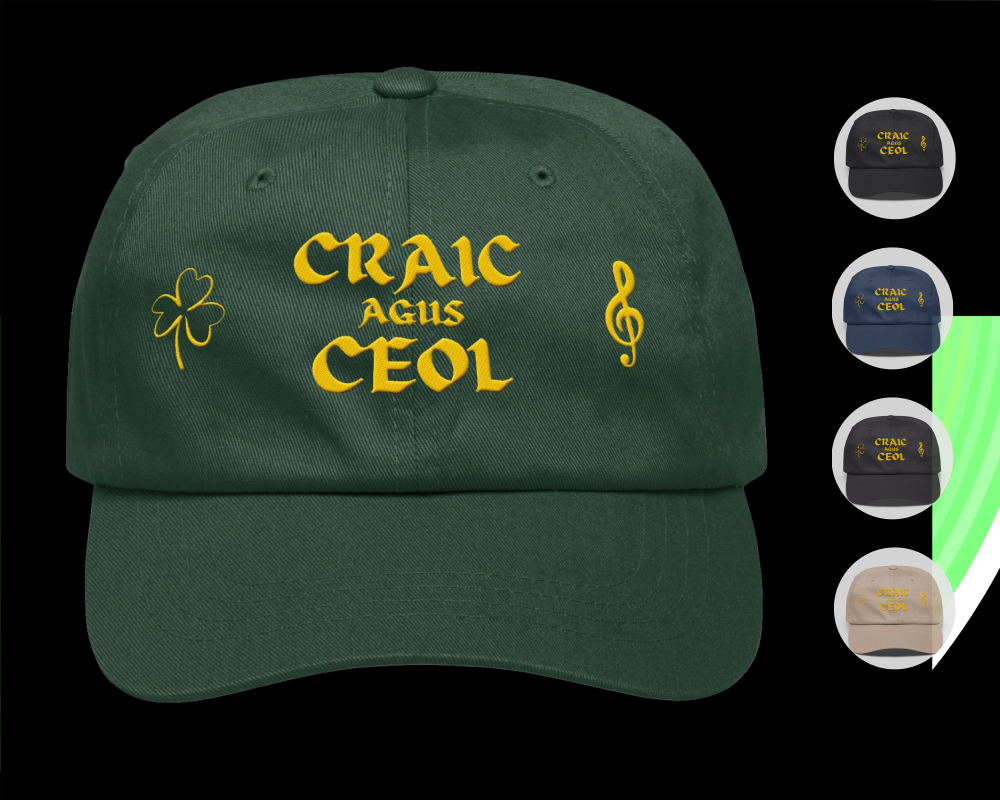
Irish Music Hat - Craic agus Ceol Classic Cap
What does 'Craic agus Ceol' mean? It simply means 'Fun and Music' in Irish. This classic cap is perfect for any session or festival, and is a great way to show your love for Irish music and culture. For a limited time also, get 10% off using the code TUNEWEB10 at checkout. Just as a thanks for using Inside Irish Music for practicing some tunes today.
Cheers,
Ronan.
Listen and Learn the Tune:
Tunes to Try Next
Disclaimer: Much of this tune background is hard to trace, and some details remain speculative. These summaries draw on trad community discussion and other available sources, and will be updated as better verified information emerges. If you spot an error or have confirmed information to add, please get in touch and I'll update the site.